Handwriting like it's 1895
I'm working on a thing set in 1895 featuring a person who is not from 1895 and the handwriting seemed like an immediate giveaway. I thought if I'm making a character learn to write properly then probably I should try too.
The traditional Victorian handwriting, copperplate script, is very familiar from archive material. My grandparents, born and educated in the 1920s, also wrote very much like this. By then it was a simplified version - they almost certainly learnt Vere Foster's Civil Service script, or something very similar.
I come from a family of primary school teachers, who all have exceptional handwriting. My brother and I look like a spider fell in an inkwell and staggered across the page. This has only become worse as I handwrite less and less. Half the time I can't read my own writing. It's like a code even I can't crack. I can get neat-enough for birthday cards and so on. But otherwise I am extremely out of practice.
So I've never been that interested in calligraphy type stuff. I don't really view this sort of writing as calligraphy. My grandparents weren't 'doing calligraphy', they were just writing.
Calligrascape lists copperplate as a final boss style - not encouraging - and a lot of stuff talks about nibs and pen holders and such. Which I know you don't need because my grandparents wrote to me in the twenty-first century in biro. So I went back to the source, to the actual copybooks they would have learnt from.
I settled on two resources. For £3.99 I bought a digitised and cleaned-up version of the first Vere Foster copybook from Charlotte Mason. Which is fantastic. When I improve I'll use the scans from The Visual Telling of Stories for more practice.
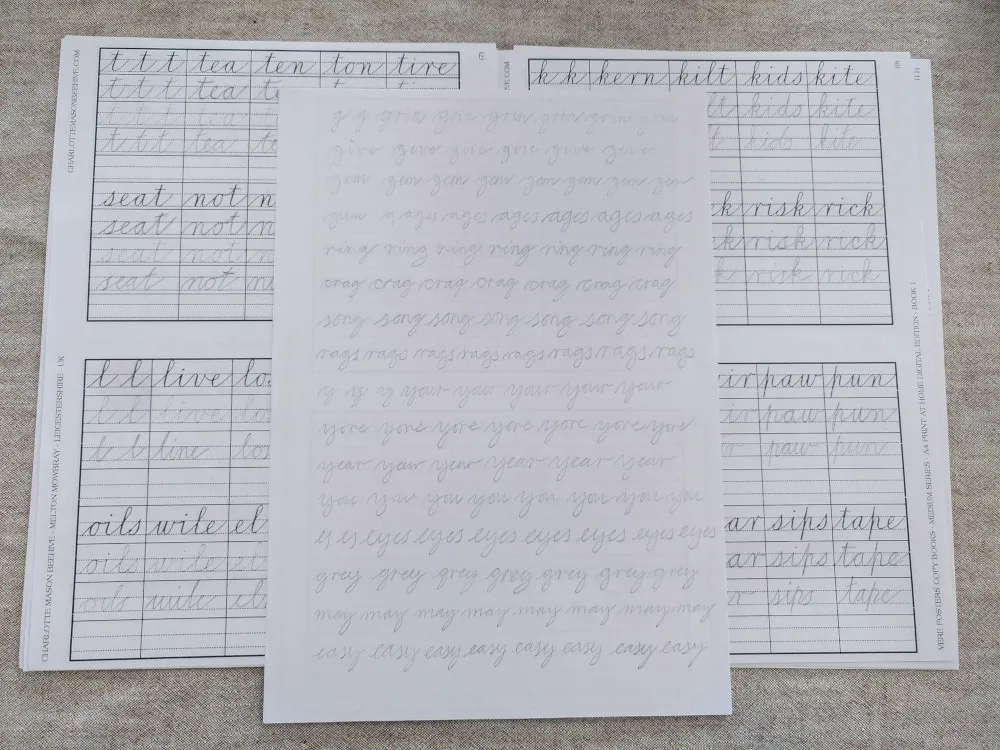
It is hard work! Which I expected it to be. My hand, wrist, even forearm ache. I can have proper form on one word then forget it all and mess up the very next identical word. Overall though, great good fun and I will continue to practice. Maybe I will graduate to capital letters and a fountain pen at some point. I'd like to try a dip pen and inkwell, in the far future.
I did get to learning a fair bit about handwriting and scripts. Copperplate itself is a version of round hand, which was designed in the 1660s. There are lots of other variations, and of course, typography. Which will have to wait for another time.
Some useful links:
- The family of English Round Hands from Penna Volans
- Her Reputation for Accomplishment: Recreating Skills and Pastimes of Jane Austen's Era has Writing a Running Hand, which is early for my purposes but very informative
- Luc Devroye has some great examples of Vere Foster's work
- Chris Mullen's The Visual Telling of Stories is an absolute treasure trove I've only just scratched the surface of, with scans of a Vere Foster copy book
- Vere Foster - one of the greatest men you've never heard of from Belfast Entries
- Vere Foster at Wikipedia but no separate page for the hand?
- some calligraphy paper templates, should I need them
- Glasgow Life's A Quick Beginner’s Guide to Reading 19th Century Cursive has great real-world examples
Filed under trying new things and doing more stuff and history and heritage