Joyride Autumn 2026
Joyride is my zinething but as a blog post. I'm trying it out. If you're on RSS I cordially invite you to take a look at the page!
Joy in the winter
It's easy for me to be joyful in the spring and summer. It is harder to find joy in the grey and the rain. So I have to choose to. Try that bit harder. I try to think, how is this great? What are the advantages, or at least the silver lining here? How can I make it joyful?
A lot of people love the autumn and winter. They like the blankets, candles, cosiness, the chill in the air, and the various winter events and celebrations.
Joys of winter:
- blue skies, getting up in the morning and seeing blue skies, even if it's a cold day, sunsets, good clouds
- getting my telescope out and getting a good view of the moon or a planet, especially when someone is visiting
- turning on the fairy lights and getting a good hot water bottle
- driving along the Diwali lights
- the hairdresser changing the art in their window
- finding cute mushrooms in the woods, bees on the ivy flowers
Beethoven, Ode to Joy, 1824
During the summer holidays the strains of Ode to Joy on the recorder were blasted across the back gardens. A classic for new learners. Probably the kid had been banished from the house. I've been there.
Ode to Joy, the ode, was written by Friedrich Schiller in 1785 then revised in 1808. The Beethoven music is properly the 9th symphony, fourth movement, written in 1824.

Is it especially joyous? I'm not sure. The joy of the ode is mostly the joy of god. It sounds slightly martial to me.
How does Maslow's hierarchy of needs account for joy, I wondered. Well. Maslow had two types of joy: Deficiency-joy and Being-joy.
Deficiency-joy is a relief of tension - the joy of scratching an itch, the joy of getting something you need. Being-joy comes in with self-actualisation and transcendence, the feeling of playfulness and aliveness.
'Aliveness' is how I've talked about feeling where it's not happiness precisely, but a very distinct feeling of being alive. Maslow talked about the difference between peak and plateau experiences - happiness could be a peak, whereas aliveness could be a plateau.
A thing of beauty is a joy for ever:
Its loveliness increases; it will never
Pass into nothingness; but still will keep
A bower quiet for us, and a sleep
Full of sweet dreams, and health, and quiet breathing.
Endymion
by John Keats
Some joys over the summer:
- dogs in car windows
- my four-year-old nephew giggling when I was copying him
- a new leaf or baby on the houseplants, the smell of tomato plants on my hands
- sheets fresh off the line, the cat trying to fight sheets on the line
- watching the flap on an air con in the ceiling that looked like it was singing along to the radio
Hope
It would be hard to find joy without hope. Is joy inherently hopeful? Is hope inherently joyous? I approach cultivating hope similarly to cultivating joy.
I wrote about Hannah Ritchie's Not the End of the World, about refusing to be doomed, highlights of my week, and sharing good things online.
More recent joys:
- a cavalcade of children on a cycling lesson coming down the road and everyone pulling over to let them pass
- admiring the art I've been framing
- the opening notes of the tai chi video in the morning
- my wife and her best friend squealing when reunited after a month
- mandoline-ing the carrots
- the sound of lots of people singing together
- the timer going off that the pizza is ready
- babies yawning
What is this? What is this?
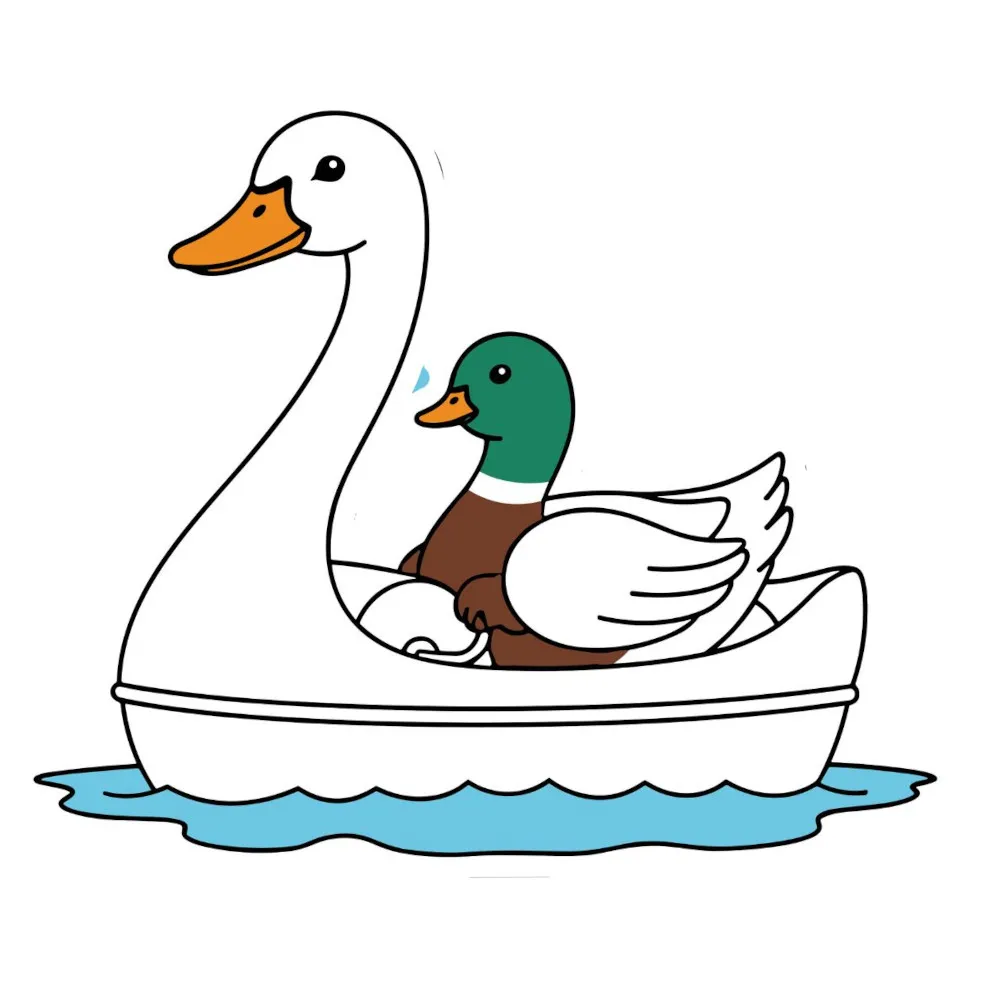
A duck in a swan boat? But it has hands? I love it. This is joy.
Jumping for joy
One of my nephews does a twitchy thing when he's excited or really into something. He glitches. Another nephew does a little hop. Literally jumping for joy.
Why do we go upwards with joy? Sinking with sadness makes sense, it's like a collapse. But when a goal is scored or a record broken whole crowds of people leap to their feet with their arms in the air. An explosion of energy and the only way is up.
This gesture of triumph is thought to be universal. Interesting how the study separates triumph and pride. How separate are triumph and joy? Even calmer, more restrained cultures project up and out with positive emotions. Did we learn to jump or did we learn to suppress it? Would we all be jumping for joy more, if we thought we could get away with it?